
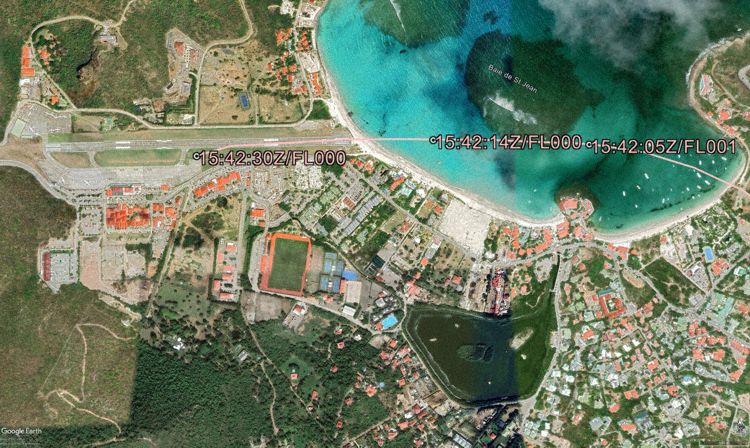
An Air Antilles Express de Havilland DHC-6-400, registration F-OMYS performing flight 3S-722 from Pointe-a-Pitre (Guadeloupe) to Saint Barthelemy (Saint Barthelemy) with 7 people on board, landed on St. Barth's runway 28 (approaching from the sea, not over the hill and road) at 11:42L (15:42Z), touched down in the touch down zone of the runway but began to veer left off the runway, went over grass towards the apron and impacted a helicopter parked at the apron, which brought the aircraft to a stop. One occupant received minor injuries, both aircraft received substantial damage.
On Sep 1st 2023 the French BEA reported, they are investigating the occurrence rated an accident. There were no injuries, however, substantial damage occurred. During landing on runway 28 the aircraft went off the runway, collided with a panel and a parked helicopter.
On Mar 13th 2026 the BEA released their final report concluding the probable causes of the accident were:
Scenario
During the landing, the nose wheel was not centred. This wheel was oriented to the left-hand side.
When the nose wheel came into contact with the ground, the aeroplane deviated to the left. The PF was unable to correct this deviation despite his actions (rudder, ailerons and then asymmetric use of reverse thrust).
The aeroplane veered off the side of the runway and collided with a helicopter parked on the dedicated stand.
The crew were not aware of the modifications to the procedures for checking the Nose Wheel Steering (NWS) system after take-off and before landing which consisted of checking that the NWS was locked in the centred position. De Havilland had introduced them in the Pilot Operating Handbook (POH) for the DHC-6 series in 2017. These modifications were not included in the operators procedures which were an adaptation of the De Havilland procedures for multi-pilot operations.
The NWS check after take-off and before landing was therefore not completely carried out, with the crew not making a manual input on the NWS lever to check that the NWS was locked in the centred position.
The tension in the NWS control cable was insufficient. It was not possible to determine the cause of this incorrect adjustment. The probable consequences of this was a situation where, on take-off, the NWS marks were aligned although the NWS was not locked in the centred position. As it was not locked, the nose wheel probably pivoted during the flight.
Contributing factors
It was not possible to determine, at the time the before landing checklist was carried out, whether the nose wheel was aligned on the aeroplanes axis. If it was, and became misaligned after the checklist was completed, the only safety barrier would have been the actual verification of NWS locking by the manual verification action on the NWS lever, as provided for by the standard procedure.
The following factors may have contributed to the crews lack of knowledge of the after take-off and before landing NWS check procedures:
- shortcomings in the operators development of the documentation which resulted in the amendment of these procedures not being included in the operating manual;
- the instructors paying insufficient attention to the carrying out of the NWS check during initial training and then in the successive training of pilots on the DHC-6.
If the wheel was already misaligned when this checklist was carried out, the visual check of the marks on the NWS lever should have identified this situation. Taking this hypothesis, the following factors may have contributed to the lack of a visual check or to its ineffectiveness:
- a distraction effect linked to the occurrence of the compensation problem in the captain's ear, concomitant with carrying out the checklist;
- a task saturation effect, even reduced attention on the part of the co-pilot, who, when the checklist was carried out, was performing the tasks of PF and PM;
- a probable lack of concentration on the part of the crew;
- the captains fatigue linked to sleep deprivation in the days preceding the accident.
Metars:
TFFJ 241700Z AUTO 02008KT //// // ////// 33/27 Q1012=
TFFJ 241630Z AUTO 03008KT //// // ////// 33/26 Q1012=
TFFJ 241600Z AUTO 02008KT //// // ////// 33/27 Q1012=
TFFJ 241530Z AUTO 02008KT //// // ////// 34/27 Q1013=
TFFJ 241500Z AUTO 02009KT //// // ////// 34/28 Q1013=
TFFJ 241430Z AUTO 03009KT //// // ////// 32/27 Q1012=
TFFJ 241400Z AUTO 03009KT //// // ////// 31/27 Q1012=
TFFJ 241330Z AUTO 04009KT //// // ////// 30/25 Q1012=
TFFJ 241300Z AUTO 04008KT //// // ////// 30/26 Q1012=
TFFJ 241230Z AUTO 05008KT //// // ////// 30/26 Q1012=
TFFJ 241200Z AUTO 06004KT 020V130 //// // ////// 29/26 Q1011=
TFFJ 241130Z AUTO VRB03KT //// // ////// 28/26 Q1011=
TFFJ 241100Z AUTO VRB01KT //// // ////// 27/26 Q1011=
Video of impact (Video: RCI Guadeloupe):
https://www.youtube.com/watch?v=YgSPzEf_C3Y
Aircraft trajectory and map (Graphics: AVH/Google Earth):
On Sep 1st 2023 the French BEA reported, they are investigating the occurrence rated an accident. There were no injuries, however, substantial damage occurred. During landing on runway 28 the aircraft went off the runway, collided with a panel and a parked helicopter.
On Mar 13th 2026 the BEA released their final report concluding the probable causes of the accident were:
Scenario
During the landing, the nose wheel was not centred. This wheel was oriented to the left-hand side.
When the nose wheel came into contact with the ground, the aeroplane deviated to the left. The PF was unable to correct this deviation despite his actions (rudder, ailerons and then asymmetric use of reverse thrust).
The aeroplane veered off the side of the runway and collided with a helicopter parked on the dedicated stand.
The crew were not aware of the modifications to the procedures for checking the Nose Wheel Steering (NWS) system after take-off and before landing which consisted of checking that the NWS was locked in the centred position. De Havilland had introduced them in the Pilot Operating Handbook (POH) for the DHC-6 series in 2017. These modifications were not included in the operators procedures which were an adaptation of the De Havilland procedures for multi-pilot operations.
The NWS check after take-off and before landing was therefore not completely carried out, with the crew not making a manual input on the NWS lever to check that the NWS was locked in the centred position.
The tension in the NWS control cable was insufficient. It was not possible to determine the cause of this incorrect adjustment. The probable consequences of this was a situation where, on take-off, the NWS marks were aligned although the NWS was not locked in the centred position. As it was not locked, the nose wheel probably pivoted during the flight.
Contributing factors
It was not possible to determine, at the time the before landing checklist was carried out, whether the nose wheel was aligned on the aeroplanes axis. If it was, and became misaligned after the checklist was completed, the only safety barrier would have been the actual verification of NWS locking by the manual verification action on the NWS lever, as provided for by the standard procedure.
The following factors may have contributed to the crews lack of knowledge of the after take-off and before landing NWS check procedures:
- shortcomings in the operators development of the documentation which resulted in the amendment of these procedures not being included in the operating manual;
- the instructors paying insufficient attention to the carrying out of the NWS check during initial training and then in the successive training of pilots on the DHC-6.
If the wheel was already misaligned when this checklist was carried out, the visual check of the marks on the NWS lever should have identified this situation. Taking this hypothesis, the following factors may have contributed to the lack of a visual check or to its ineffectiveness:
- a distraction effect linked to the occurrence of the compensation problem in the captain's ear, concomitant with carrying out the checklist;
- a task saturation effect, even reduced attention on the part of the co-pilot, who, when the checklist was carried out, was performing the tasks of PF and PM;
- a probable lack of concentration on the part of the crew;
- the captains fatigue linked to sleep deprivation in the days preceding the accident.
Metars:
TFFJ 241700Z AUTO 02008KT //// // ////// 33/27 Q1012=
TFFJ 241630Z AUTO 03008KT //// // ////// 33/26 Q1012=
TFFJ 241600Z AUTO 02008KT //// // ////// 33/27 Q1012=
TFFJ 241530Z AUTO 02008KT //// // ////// 34/27 Q1013=
TFFJ 241500Z AUTO 02009KT //// // ////// 34/28 Q1013=
TFFJ 241430Z AUTO 03009KT //// // ////// 32/27 Q1012=
TFFJ 241400Z AUTO 03009KT //// // ////// 31/27 Q1012=
TFFJ 241330Z AUTO 04009KT //// // ////// 30/25 Q1012=
TFFJ 241300Z AUTO 04008KT //// // ////// 30/26 Q1012=
TFFJ 241230Z AUTO 05008KT //// // ////// 30/26 Q1012=
TFFJ 241200Z AUTO 06004KT 020V130 //// // ////// 29/26 Q1011=
TFFJ 241130Z AUTO VRB03KT //// // ////// 28/26 Q1011=
TFFJ 241100Z AUTO VRB01KT //// // ////// 27/26 Q1011=
Video of impact (Video: RCI Guadeloupe):
https://www.youtube.com/watch?v=YgSPzEf_C3Y
Aircraft trajectory and map (Graphics: AVH/Google Earth):
This article is published under license. Article Source
Published Date