
An Air Canada Rouge Airbus A319-100 on behalf of Air Canada, registration C-GSJB performing flight AC-1717 from Toronto,ON (Canada) to Nashville,TN (USA), landed on Nashville's runway 20L at 17:23L (22:23Z) but touched down short of the runway. The aircraft rolled out without further incident and taxied to the apron.
The return flight was cancelled. The aircraft is still on the ground in Nashville about 41 hours after landing.
The NTSB opened an investigation into the occurrence.
On Sep 10th 2025 the NTSB published their preliminary report summarizing the sequence of events:
The flight crew consisted of a Line Indoctrination Training Captain, seated in the right seat, and serving as the pilot monitoring (PM), and a captain candidate, seated in the left seat, serving as the pilot flying (PF).
The crew reported that ATC initially instructed them to expect a visual approach to runway 20L. However, due to rain over the airport, ATC later amended the clearance to the RNAV (GPS) Y 20L approach. The flight was cleared to the initial approach fix (IAF) WAYLN, then given radar vectors and subsequently cleared for the approach.
The airplane was configured for landing at approximately 1,100 feet and met the operators stabilized approach criteria at both 1,000 and 500 feet; however, the stable call at 500 feet was missed by the PM. At the decision altitude (DA), the autopilot was disconnected. Around 200 feet above ground level (AGL), the crew encountered heavy rain, and the PF requested activation of the windshield wipers.
Shortly after, the PF stated he had lost the runway but still believed the runway environment was visible. He asked whether a go-around should be initiated. The PM, who could see the runway environmentalbeit distorted by rainand believed the aircraft was on the glide path, responded that they were good to continue.
At 20 to 30 feet radio altitude, the crew retarded the thrust levers to idle. About the same time, the PF was startled to see the runway threshold lights directly ahead of the aircrafts nose. The crew perceived that the airplane touched down on the blast pad, a paved surface preceding the runway threshold. The remainder of the landing rollout and taxi were uneventful.
Airport video surveillance captured the incident sequence and showed the airplane as it touched down short of the runway. Following the initial touchdown, the airplane rolled onto the pavement and impacted a runway threshold light.
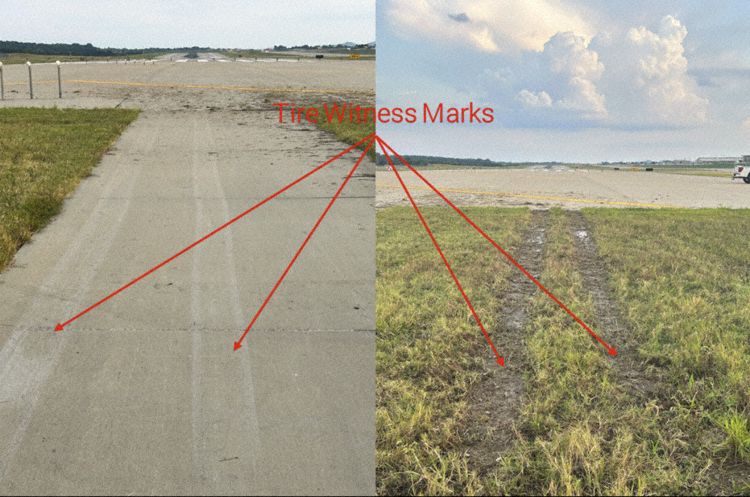
A post-incident inspection by airport personnel revealed that the left main landing gear contacted an airport service road approximately 420 feet short of the runway threshold.
The right main landing gear touched down approximately 52 feet short of the paved surface, which was about 430 feet short of the runway threshold.
A post flight inspection by maintenance personnel revealed mud on the airplanes empennage and minor damage to one of the airplanes tires.
https://flightaware.com/live/flight/ROU1717/history/20250814/2050Z/CYYZ/KBNA
Metars:
KBNA 150053Z 03008KT 10SM SCT055TCU BKN110 BKN250 29/21 A3001 RMK AO2 SLP156 TCU NE-S T02940211 $=
KBNA 142353Z 02010KT 10SM SCT050TCU SCT110 BKN250 31/22 A2999 RMK AO2 SLP149 TCU N-E T03110217 10344 20311 53007 $=
KBNA 142253Z 07005KT 10SM FEW050 SCT110 SCT250 33/21 A2998 RMK AO2 SLP144 T03280211 $=
KBNA 142153Z 19005KT 10SM SCT050TCU SCT085 BKN250 34/20 A2998 RMK AO2 SLP145 TCU OHD AND W-N T03390200 $=
KBNA 142053Z VRB04KT 10SM SCT050 SCT250 33/20 A2997 RMK AO2 SLP142 CB DSNT NE T03330200 58015 $=
KBNA 141953Z 18004KT 10SM SCT047 SCT055 BKN250 33/21 A2999 RMK AO2 SLP148 TCU DSNT W T03280206 $=
KBNA 141853Z 22005KT 10SM SCT044TCU BKN060 BKN250 33/21 A3001 RMK AO2 SLP156 TCU ALQDS T03280206 $=
KBNA 141753Z 27004KT 10SM SCT038TCU SCT250 33/21 A3002 RMK AO2 SLP158 TCU NE AND SE AND W-NW T03280206 10328 20228 58011 $=
Witness Marks (Photo: NTSB):
The return flight was cancelled. The aircraft is still on the ground in Nashville about 41 hours after landing.
The NTSB opened an investigation into the occurrence.
On Sep 10th 2025 the NTSB published their preliminary report summarizing the sequence of events:
The flight crew consisted of a Line Indoctrination Training Captain, seated in the right seat, and serving as the pilot monitoring (PM), and a captain candidate, seated in the left seat, serving as the pilot flying (PF).
The crew reported that ATC initially instructed them to expect a visual approach to runway 20L. However, due to rain over the airport, ATC later amended the clearance to the RNAV (GPS) Y 20L approach. The flight was cleared to the initial approach fix (IAF) WAYLN, then given radar vectors and subsequently cleared for the approach.
The airplane was configured for landing at approximately 1,100 feet and met the operators stabilized approach criteria at both 1,000 and 500 feet; however, the stable call at 500 feet was missed by the PM. At the decision altitude (DA), the autopilot was disconnected. Around 200 feet above ground level (AGL), the crew encountered heavy rain, and the PF requested activation of the windshield wipers.
Shortly after, the PF stated he had lost the runway but still believed the runway environment was visible. He asked whether a go-around should be initiated. The PM, who could see the runway environmentalbeit distorted by rainand believed the aircraft was on the glide path, responded that they were good to continue.
At 20 to 30 feet radio altitude, the crew retarded the thrust levers to idle. About the same time, the PF was startled to see the runway threshold lights directly ahead of the aircrafts nose. The crew perceived that the airplane touched down on the blast pad, a paved surface preceding the runway threshold. The remainder of the landing rollout and taxi were uneventful.
Airport video surveillance captured the incident sequence and showed the airplane as it touched down short of the runway. Following the initial touchdown, the airplane rolled onto the pavement and impacted a runway threshold light.
A post-incident inspection by airport personnel revealed that the left main landing gear contacted an airport service road approximately 420 feet short of the runway threshold.
The right main landing gear touched down approximately 52 feet short of the paved surface, which was about 430 feet short of the runway threshold.
A post flight inspection by maintenance personnel revealed mud on the airplanes empennage and minor damage to one of the airplanes tires.
https://flightaware.com/live/flight/ROU1717/history/20250814/2050Z/CYYZ/KBNA
Metars:
KBNA 150053Z 03008KT 10SM SCT055TCU BKN110 BKN250 29/21 A3001 RMK AO2 SLP156 TCU NE-S T02940211 $=
KBNA 142353Z 02010KT 10SM SCT050TCU SCT110 BKN250 31/22 A2999 RMK AO2 SLP149 TCU N-E T03110217 10344 20311 53007 $=
KBNA 142253Z 07005KT 10SM FEW050 SCT110 SCT250 33/21 A2998 RMK AO2 SLP144 T03280211 $=
KBNA 142153Z 19005KT 10SM SCT050TCU SCT085 BKN250 34/20 A2998 RMK AO2 SLP145 TCU OHD AND W-N T03390200 $=
KBNA 142053Z VRB04KT 10SM SCT050 SCT250 33/20 A2997 RMK AO2 SLP142 CB DSNT NE T03330200 58015 $=
KBNA 141953Z 18004KT 10SM SCT047 SCT055 BKN250 33/21 A2999 RMK AO2 SLP148 TCU DSNT W T03280206 $=
KBNA 141853Z 22005KT 10SM SCT044TCU BKN060 BKN250 33/21 A3001 RMK AO2 SLP156 TCU ALQDS T03280206 $=
KBNA 141753Z 27004KT 10SM SCT038TCU SCT250 33/21 A3002 RMK AO2 SLP158 TCU NE AND SE AND W-NW T03280206 10328 20228 58011 $=
Witness Marks (Photo: NTSB):
This article is published under license. Article Source
Published Date