
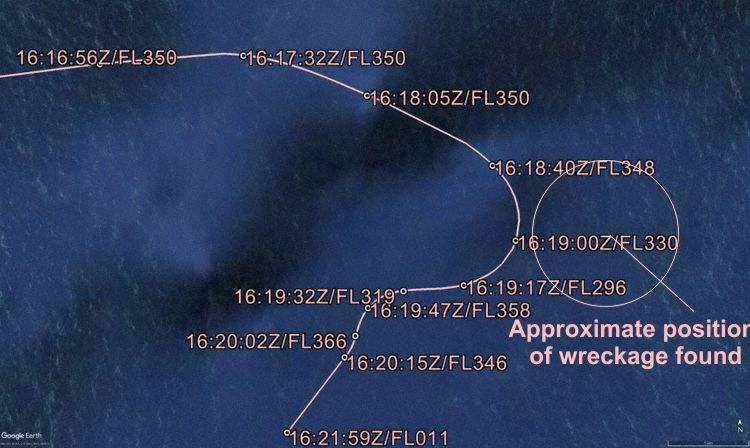
A K2 Cargo Airways Boeing 737-400 freighter, registration AP-BOI performing flight KTA-1732 from Sharjah (United Arab Emirates) to Karachi (Pakistan) with 5 crew, was enroute at FL350 over the Arabian Sea about 150nm west of Karachi when the crew reported problems with their navigational systems, ATC began to issue vectors. About 3 minutes later the aircraft suddenly made heading changes and rapidly descended until impacting the sea. A search is underway.
Pakistan's Airport Authority reported the K2 Airways flight with 5 crew reported a navigational system issue at 21:18 local time and received guidance by Karachi Air Traffic Control Center. 3 minutes later, at 21:21L the aircraft was seen rapidly descending with rapid heading changes, radar contact was lost about 155nm west of Karachi. A search and rescue operation was launched.
Pakistan's Prime Minister said, that the aircraft crashed into the Arabian Sea and expressed his deep sorrow, grief and regret over the tragic occurrence.
On Jul 8th 2026 Pakistan's Airport Authority (PAA) reported that the wreckage has been found about 53nm south of Ormara (Pakistan) after about 12 hours of intense search.
The airplane had undergone maintenance in Sharjah and was positioning back to Pakistan after maintenance was completed.
On Jul 9th 2026 information surfaced in Pakistan, that the aircraft's Inertial Reference System had become faulty in Sharjah after arrival on Jun 28th 2026. Repairs were done and the aircraft was released to service on Jul 7th 2026.
On Jul 10th 2026 the PAA reported that additional debris has been recovered and has been sent for analysis. The search for the black boxes continues.
The waters at the crash site are between 2500 and 3500 meters deep with uneven seabed.
An underwater search and recovery operation is estimated to begin in August 2026 with the aim to recover FDR and CVR.
On Jan 1st 2007 an Adam Air Boeing 737-400 registration PK-KKW had suffered the failure of one of their IRS systems in cruise flight at FL350 and subsequently impacted the sea. The final report of the crash of PK-KKW by Indonesia's KNKT is available via the Australian ATSB. The report summarizes the sequence of events:
The DFDR analysis showed that the aircraft was in cruise at FL 350 with the autopilot engaged. The autopilot was holding 5 degrees left aileron wheel in order to maintain wings level. Following the crews selection of the number-2 (right) IRS Mode Selector Unit to ATT (Attitude) mode, the autopilot disengaged. The control wheel (aileron) then centered and the aircraft began a slow roll to the right. The aural alert, BANK ANGLE, sounded as the aircraft passed 35 degrees right bank.
The DFDR data showed that roll rate was momentarily arrested several times, but there was only one significant attempt to arrest the roll. Positive and sustained roll attitude recovery was not achieved. Even after the aircraft had reached a bank angle of 100 degrees, with the pitch attitude approaching 60 degrees aircraft nose down, the pilot did not roll the aircrafts wings level before attempting pitch recovery in accordance with standard operating procedures. The aircraft reached 3.5g, as the speed reached Mach 0.926 during sustained nose-up elevator control input while still in a right bank. The recorded airspeed exceeded Vdive (400 kcas), and reached a maximum of approximately 490 kcas just prior to the end of recording.
A thump, thump sound was evident on the CVR about 20 seconds from the end of the recorded data. Flight recorder data indicated that a significant structural failure occurred when the aircraft was at a speed of Mach 0.926 and the flight load suddenly and rapidly reversed from 3.5g to negative 2.8 g. This g force and airspeed are beyond the design limitations of the aircraft. At the time of the thump, thump sound, the aircraft was in a critically uncontrollable state.
The PIC did not manage task sharing and crew resource management practices were not followed. There was no evidence that the pilots were appropriately controlling the aircraft, even after the BANK ANGLE alert sounded as the aircrafts roll exceeded 35 degrees rightbank.
On Jan 25th 2010 an Ethiopian Airlines Boeing 737-800 registration ET-ANB crashed shortly after departure from Beirut after similiar heading, altitude and speed changes, see final report of the crash of ET-ANB via the BEA and our coverage. The report, contested by the airline, concluded the probable causes of the crash were:
- The flight crew's mismanagement of the aircraft's speed, altitude, headings and attitude through inconsistent flight control inputs resulting in a loss of control.
- The flight crew failure to abide by CRM principles of mutual support and calling deviations hindered any timely intervention and correction.
Trajectory (Graphics: AVH/Google Earth):
Pakistan's Airport Authority reported the K2 Airways flight with 5 crew reported a navigational system issue at 21:18 local time and received guidance by Karachi Air Traffic Control Center. 3 minutes later, at 21:21L the aircraft was seen rapidly descending with rapid heading changes, radar contact was lost about 155nm west of Karachi. A search and rescue operation was launched.
Pakistan's Prime Minister said, that the aircraft crashed into the Arabian Sea and expressed his deep sorrow, grief and regret over the tragic occurrence.
On Jul 8th 2026 Pakistan's Airport Authority (PAA) reported that the wreckage has been found about 53nm south of Ormara (Pakistan) after about 12 hours of intense search.
The airplane had undergone maintenance in Sharjah and was positioning back to Pakistan after maintenance was completed.
On Jul 9th 2026 information surfaced in Pakistan, that the aircraft's Inertial Reference System had become faulty in Sharjah after arrival on Jun 28th 2026. Repairs were done and the aircraft was released to service on Jul 7th 2026.
On Jul 10th 2026 the PAA reported that additional debris has been recovered and has been sent for analysis. The search for the black boxes continues.
The waters at the crash site are between 2500 and 3500 meters deep with uneven seabed.
An underwater search and recovery operation is estimated to begin in August 2026 with the aim to recover FDR and CVR.
On Jan 1st 2007 an Adam Air Boeing 737-400 registration PK-KKW had suffered the failure of one of their IRS systems in cruise flight at FL350 and subsequently impacted the sea. The final report of the crash of PK-KKW by Indonesia's KNKT is available via the Australian ATSB. The report summarizes the sequence of events:
The DFDR analysis showed that the aircraft was in cruise at FL 350 with the autopilot engaged. The autopilot was holding 5 degrees left aileron wheel in order to maintain wings level. Following the crews selection of the number-2 (right) IRS Mode Selector Unit to ATT (Attitude) mode, the autopilot disengaged. The control wheel (aileron) then centered and the aircraft began a slow roll to the right. The aural alert, BANK ANGLE, sounded as the aircraft passed 35 degrees right bank.
The DFDR data showed that roll rate was momentarily arrested several times, but there was only one significant attempt to arrest the roll. Positive and sustained roll attitude recovery was not achieved. Even after the aircraft had reached a bank angle of 100 degrees, with the pitch attitude approaching 60 degrees aircraft nose down, the pilot did not roll the aircrafts wings level before attempting pitch recovery in accordance with standard operating procedures. The aircraft reached 3.5g, as the speed reached Mach 0.926 during sustained nose-up elevator control input while still in a right bank. The recorded airspeed exceeded Vdive (400 kcas), and reached a maximum of approximately 490 kcas just prior to the end of recording.
A thump, thump sound was evident on the CVR about 20 seconds from the end of the recorded data. Flight recorder data indicated that a significant structural failure occurred when the aircraft was at a speed of Mach 0.926 and the flight load suddenly and rapidly reversed from 3.5g to negative 2.8 g. This g force and airspeed are beyond the design limitations of the aircraft. At the time of the thump, thump sound, the aircraft was in a critically uncontrollable state.
The PIC did not manage task sharing and crew resource management practices were not followed. There was no evidence that the pilots were appropriately controlling the aircraft, even after the BANK ANGLE alert sounded as the aircrafts roll exceeded 35 degrees rightbank.
On Jan 25th 2010 an Ethiopian Airlines Boeing 737-800 registration ET-ANB crashed shortly after departure from Beirut after similiar heading, altitude and speed changes, see final report of the crash of ET-ANB via the BEA and our coverage. The report, contested by the airline, concluded the probable causes of the crash were:
- The flight crew's mismanagement of the aircraft's speed, altitude, headings and attitude through inconsistent flight control inputs resulting in a loss of control.
- The flight crew failure to abide by CRM principles of mutual support and calling deviations hindered any timely intervention and correction.
Trajectory (Graphics: AVH/Google Earth):
This article is published under license. Article Source
Published Date